Starting with basics and working all the way to confident, show-stopping works, an ink painting course is a road trip. Consider it as a road; the early steps count just as much as the jumps toward the conclusion. Beginning students learn the basis in the first classes. You will come to know the several inks: vivid alcohol inks, traditional water-based formulations, even melancholy India ink. Walking you through tool options—aquaint brushes, smooth Yupo paper, weird droppers, and odd household utensils that prove to be secret weapons—the instructor guides you.
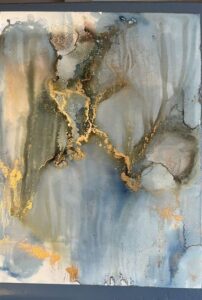
These introductory sessions calm your nerves. Works on control are the exercises. Discover what happens with a flick of the wrist against a slow, steady pull; how to load your brush just right; measure how far a single drop may fly. Watching ink bleed on fresh paper for the first time always has a little magical effect.
Pretty soon the course turns its focus differently. Now comes layering: once you know the secret, transparent washes, overlapping hues, subtle gradients look nearly easy. Perhaps your tutor will demonstrate to you how to drop alcohol on a half-finished piece to produce halos that appear cosmic or lift ink for highlights. Accidental messes suddenly become repeated experiments worth doing.
You will experience texture creation once you feel comfortable. Some classes gently encourage you to dabble with masking fluid or sprinkle salt. Ever experimented with straw-based blowing of ink? That anarchy blossoms in wild, organic shapes. Every project tests you: scenes where rivers split and meander, flowery explosions bursting with movement, fluid abstracts suggesting galaxies or oceans.
Moving to more complex subjects, purpose becomes increasingly important. Compositional quality counts. You’ll begin guiding viewers’ eyes throughout your work, balancing strong colors with softer parts. Sessions covering line work—calligraphic strokes for emphasis or delicate contours to ground those light ink swirls—may be especially important.
Group projects and criticism throughout help hone your abilities. You witness how other students tackle related issues, frequently revealing original ideas you would never have considered alone.
By the last module, you have a toolkit of layering, blending, lifting, mixing media techniques. At first, what seemed like a random experiment feels like a regulated creative language now. You go with bits ready for framing, maybe even a spark to keep on your own personal exploration. And quite honestly? A small ink smear on your fingers seems oddly like a medal of pride.